
Start a Tippah Property Search
The cleanest path through Tippah County property records runs from the parcel onward. It ends at the related documents. An address fits the assessor or the map. An owner name suits Delta Property Link or the Chancery instrument index. A parcel number or PPIN beats both for precision. Rural land often lacks a dependable street number. Section, township and range can also pinpoint land in the paid county systems.
Hold onto every identifier a first result hands you. The parcel number ties tax data to the map. Deed book and page, or an instrument number, tie the parcel back to its recorded transfer. A mailing address proves nothing about residency. A map polygon, in the same way, is a tax reference. It is not a survey line.
- Search the assessor data by address, name, parcel number, PPIN or land description.
- Write down the owner name, parcel keys, legal description and deed reference.
- Check the Chancery Clerk's instrument index for the deed, mortgage, release or lien.
- Compare the parcel with the county GIS and the public state parcel layer.
- Ask the responsible office for a certified copy or an older record not online.
The Tippah County property search page covers each field. The web path is not complete. Delta cautions that its privately maintained data may lag or omit courthouse activity, so confirm anything important with the office that holds the record.
Tippah County Records Offices
Three county desks divide the main work. The Chancery Clerk serves as the public recorder for deeds and land-related instruments. The Tax Assessor identifies, classifies and values parcels for the annual roll. The Tax Collector bills and collects ad valorem tax and runs the annual sale required for unpaid taxes or special assessments. Assessor and collector sit on Main Street. The rooms and phone numbers differ.
Search Tippah Records by Key
The paid Delta Property Link takes a name in last-name-first order, an address, a parcel number, section-township-range or PPIN. Its appraisal form accepts name, address, parcel number and PPIN. Subscription access costs $30 per month or $330 per year. It is a practical index, not the official tax roll. View the assessor search fields before choosing a query. The Tippah County property-records screen displays each search route alongside the paid access notice.
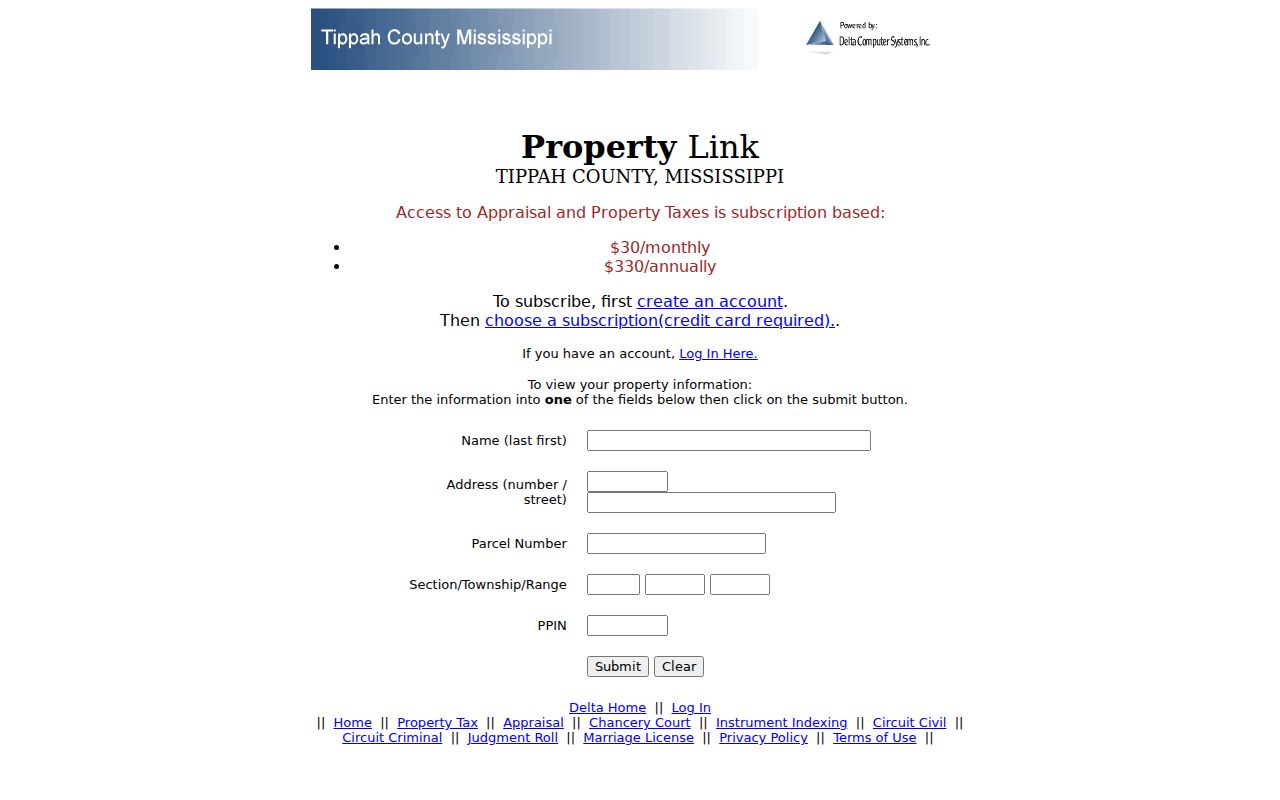
PPIN and parcel number fix uncertain matches when a name or rural address gets fuzzy.
Tippah Parcel Data Bridges Offices
The public Mississippi Forestry Commission parcel layer exposes the fields that connect a mapped polygon to courthouse and tax material. Its schema runs long. It includes parcel number, PPIN, name, address, city, ZIP, township, range, section, subdivision, map, block, legal description, deed book and page, sale price, total assessed value, acreage and homestead codes. Not every field is filled for every parcel. The schema is not a certified parcel card.
The Tippah parcel REST layer also supports JSON and GeoJSON queries, query by distance and up to 1,000 records. That technical access can test a result. It works even where Delta's paywall blocks you.
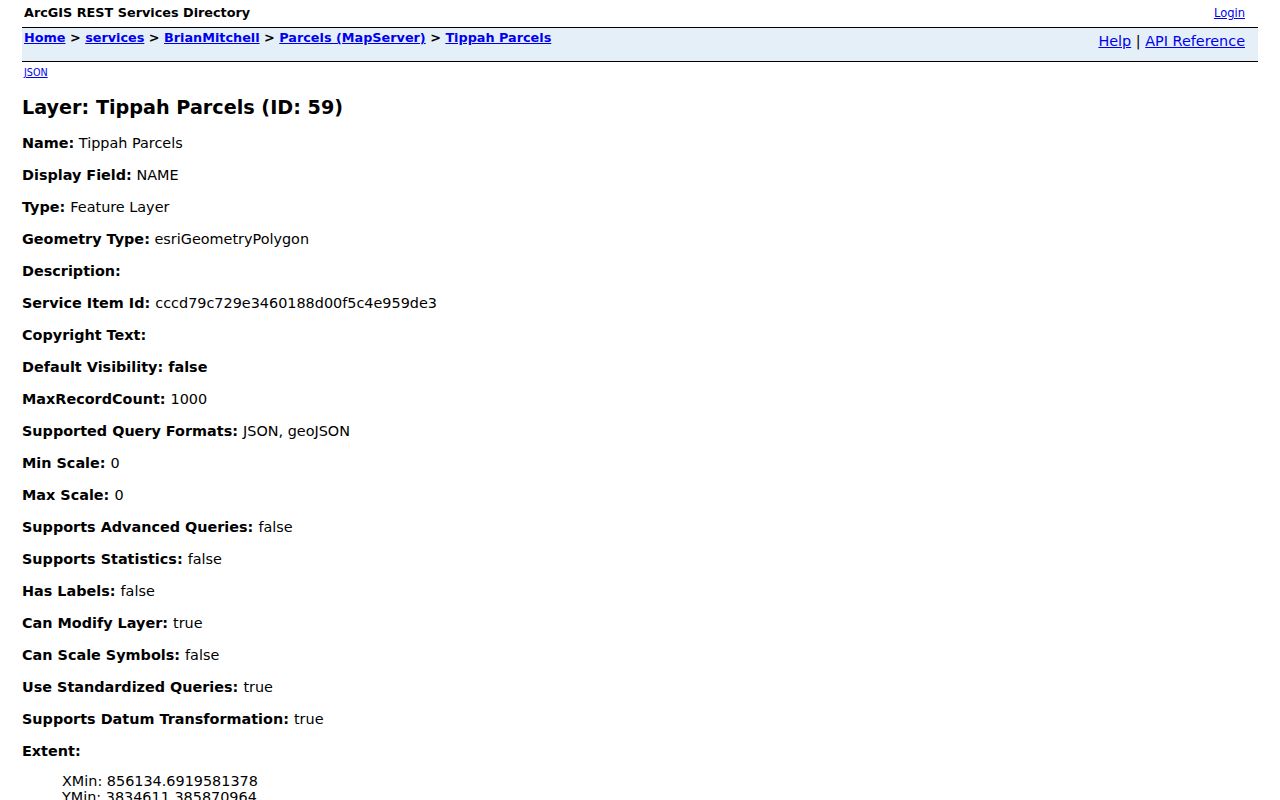
Deed and survey still control title and legal boundaries.
Tippah Property Record Types
Each record answers a different question. Deeds document conveyances, and assessment records tie an owner and value to the January 1 roll. Tax files show bills, payments, delinquency and sales. Parcel maps supply reference geography, while court files may disclose title disputes, estates, foreclosures and lis pendens.
| Record Type | What It Documents | Kept By | Access |
|---|---|---|---|
| Deeds | Transfers, parties, legal descriptions | Chancery Clerk | Paid Delta index; counter; archives |
| Mortgages and liens | Recorded claims and releases | Chancery Clerk | Instrument and judgment indexes |
| Assessment and tax | Owner, class, value, homestead, bill | Assessor and Collector | Paid portal; office request |
| Plats and parcels | Lot, block, acreage, map reference | Chancery Clerk and GIS | Public viewers; recorded plat |
| Permits and zoning | Work and local land-use approvals | Municipality | City portal or clerk request |
A sale or ownership trail belongs in Tippah County deed records, not the GIS line. A tax balance sits with the collector. Boundary questions start with the plat and deed.
Tippah Deed Coverage Has Layers
Delta's current land-instrument index reaches July 2012 forward. Its form searches grantor or grantee, partial name, book and page, filing date, section-township-range, subdivision and lot, or instrument number. Chancery cases reach to 2000 in Delta, while Circuit and judgment products state 2008 forward. Those cutoffs explain why a recent web search cannot establish a long chain of title.
The older trail is unusually rich. FamilySearch's Tippah collection contains more than 115,000 images, including deed books from 1836 through 1901 and probate through 1923. Its catalog carries deed indexes through 1914. Some images may need a login or center visit.
That historic collection can restore the early links missing from the current paid index.
Note: Online absence is not proof that a Tippah County deed or land record does not exist.
January 1 Controls Tippah Taxes
Mississippi assesses real property annually to the owner of record on January 1. Bills generally issue in November or December. They fall due the next February 1. A closing after January 1 can leave the prior owner on the tax account until the next assessment cycle, even after a newer deed is recorded.
Mississippi applies a 10 percent assessment ratio to Class I owner-occupied single-family residential property and 15 percent to Class II other real property. The basic formula multiplies true value by the ratio and then by millage. Homestead applicants file with the county. The window runs January 1 to April 1. State eligibility rules govern.
Tippah Tax-Sale Research Paths
A Tippah County tax-sale question always has two halves. The Tax Collector tracks delinquent taxes and runs the annual sale. The Chancery Clerk holds everything after that. That includes redemption files, maturity records and any final conveyance. Stopping at the first web result leaves the picture incomplete. Start with the collector for delinquency status. Then ask Chancery about redemption, required notices and what the land actually became.
The Mississippi Tax-Forfeited Inventory Map launched in May 2025. It searches state-held inventory by county, parcel number, PPIN or a drawn area. It is not Tippah County's current tax roll. It does not replace the county's own sale file.
Old Jail Archives Preserve Tippah
The Tippah County Archives sits inside the Old Jail at 201 N. Union Street, and its shelves reach back to the county's 1836 founding. Deeds from that early era survive there. So do tax assessor records, old maps, Chancery and Circuit material, and county minutes. The local historical society reports that papers once sat in the courthouse attic and basement. Those papers have since been moved and indexed. Start with the Mississippi Digital Library archive description, then call 662-837-3353 about access. For deeper Tippah County property records, Mississippi Department of Archives and History finding aids can help. They list selected land records from 1852. They also cover tax levy orders spanning 1850 through 1859, and a delinquent-land list from 1852.

This preservation effort explains why the courthouse and the Old Jail archives still matter when a modern property search comes up empty.
Tippah Addresses Need Context
New 911 addresses in Tippah County are assigned through the Justice Court building at 205-B W. Spring Street. Staff there rely on the nearest road and neighboring properties to pinpoint rural sites. Keep in mind that a postal place name is not a municipal boundary. ZIP labels here include Blue Mountain, Dumas, Falkner, Ripley, Tiplersville and Walnut. A Ripley mailing address can sit well past Ripley city limits.
Always compare three things. Situs means the physical location of the parcel. A mailing address simply routes the tax bill. It may belong to a trustee, a bank, a representative, or an owner of record who lives elsewhere. The deed's legal description governs the conveyance itself. It may rely on lot and block or on section, township and range rather than any street address at all.
Limits of Tippah Property Records
Tippah County property records can tell you plenty. They show the assessed owner of record, recorded transfers, and tax value. They also show the parcel number, map shape, and instruments in the public index. What they cannot do is prove a clear title. They cannot settle a disputed boundary, establish who occupies a home, or forecast a sale price. Trusts, companies, and estates may hold title instead of individuals. Exempt or confidential data may also be withheld from view.
An official record is not the same as commercial compiled data. The recorder or assessor can certify a document and explain current access rules. A commercial tool may run stale. It may blend people with similar names or miss a recent deed filing. Treat it only as a lead. Then return to the custodian of the tax roll and deed records.
Lawful use. Tippah County records support purchase research, boundary work, tax review and civic transparency. They do not replace a title opinion or licensed survey, and must never be used to harass or harm a person.