
Tippah Current Owner Record Fields
A Tippah owner-of-record result is a set of clues, never a title opinion. One parcel schema can hold the name, several address lines, a parcel number, PPIN, deed book and page, legal description, sale fields, assessed values, and a homestead code. Read the fields as a whole. A name sitting on the wrong parcel is not a match. Nor is a deed reference tied to some other legal description.
| Owner or name | Assessor or GIS lead for the party attached to the parcel |
|---|---|
| Mailing address | Destination for tax notices, which may be away from the land |
| Situs address | Physical location used to identify the parcel |
| Parcel number and PPIN | Keys for matching assessor, map, and deed work |
| Deed book/page | Pointer to a recorded instrument |
| Sale date and price | Transfer lead requiring deed confirmation |
The record names an owner, not every occupant. A mailing address may belong to a post office box, a bank, a trustee, an attorney, or an owner living outside Tippah County. Use it only for lawful contact about the land.
January 1 Sets Tippah Ownership
Mississippi assesses each property to its January 1 owner. That annual snapshot can linger after a later sale, so the assessor's current owner may trail the newest recorded deed. Compare the dates first. Check the tax year, sale date, deed date, and recording date before calling a mismatch an error, since a fresh conveyance can be valid while the roll still shows the earlier name.
This lag is why the present-owner question spans two offices. The Tax Assessor can explain an ownership update. The Chancery Clerk holds the recorded conveyance. The Tax Collector's bill follows the tax cycle and never decides title on its own.
Note: A January 1 roll is an annual tax snapshot; the newest recorded deed may identify a more recent owner.
View Tippah Appraisal Search Fields
The Delta appraisal search accepts owner, address, parcel, and PPIN inputs. Access runs on a subscription. The county landing page lists $30 monthly or $330 annually. The official search page displays its entry fields plainly. It shows no sample parcel card. So treat any card layout or value figure as unknown until an actual record appears.
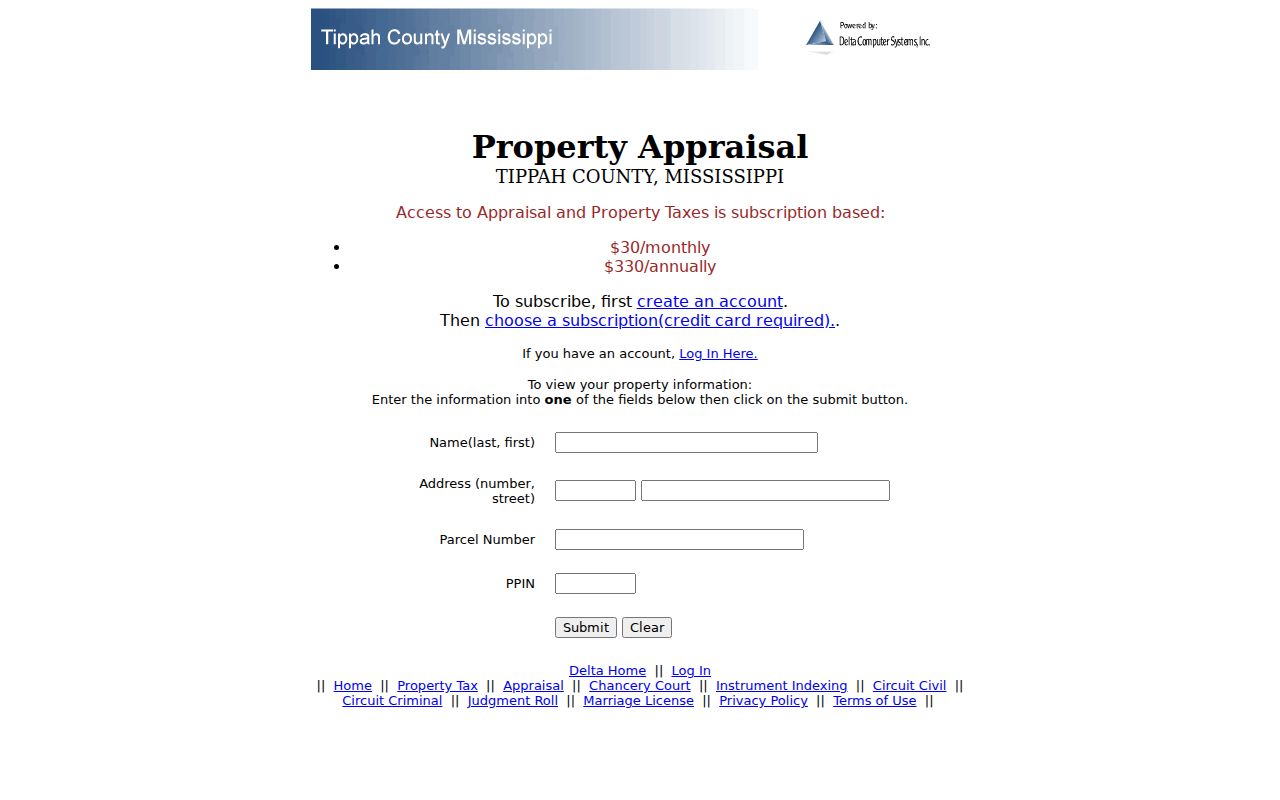
Use the narrowest key you have, since a PPIN or parcel number sidesteps most same-name and address-format problems.
Confirm Tippah's Current Owner
To confirm ownership, match the roll entry to the most recent deed for the same land. Delta's instrument index starts at July 2012. Grantor and grantee names, partial names, book and page, dates, section-township-range, subdivision and lot, and instrument numbers all work as queries. Older records belong at the Chancery Clerk.
- Find the parcel in Delta Property Link by address, owner, parcel number, PPIN, or rural land description.
- Copy the owner entry, roll year, legal description, and deed reference.
- Search the Chancery instrument index for the latest matching grantee and tract.
- Request the official deed from the courthouse if timing, vesting, or the legal description remains uncertain.
- Owner of record
- The party a given official record associates with the parcel.
- Vesting
- The deed language stating who holds the interest and in what form.
- Grantee
- The person or entity receiving the interest stated in a deed.
- Registered agent
- A business entity's official service contact, not automatically the landowner.
Read Tippah Deed Vesting
One assessor name can flatten a complicated interest. The deed may vest title in spouses, several grantees, a trustee, or a business. It may also name a life tenant with a remainder beneficiary. The legal words matter. Never infer ownership shares or the power to sell from a short parcel field.
For an LLC, run the exact entity name through the Mississippi business search. It accepts business name, ID, officer, or registered agent. For a trust, search both the trustee and trust names. For an estate, the Tippah Chancery probate case can reveal an administrator, heirs, or the transfer. That transfer comes before a later deed. Entity and probate records explain names. The recorded deed still governs the land.
Separate Tippah Situs and Mail
Situs is where the land sits. Mailing is where the tax notice goes. They need not match. A rural Tippah tract can carry a postal city label unlike its municipal status, and a Ripley ZIP can reach beyond the city limits. A post office box proves nothing about occupancy. Nor does an out-of-county address.
When the situs address fails, compare the parcel map, PPIN, legal description, and section-township-range. Tippah County's Justice Court route assigns 911 addresses and asks for the nearest street and neighbors. That local check can identify the tract without turning a mailing clue into an ownership conclusion.
Get an Official Tippah Copy
For a certified, definitive record, contact Tippah County Chancery Clerk Shana Lowry at 115 E. Spring Street, Ripley, MS 38663, or 662-837-7374. Her office records deeds, mortgages, construction and condominium liens, federal tax liens, lis pendens, and land indexes. Delta's online results are handy indexes. The courthouse record still controls.
The Tax Assessor sits at 102-D North Main Street, 662-837-9956, and can explain roll fields or update timing. Other nonexempt records may be requested under the Mississippi Public Records Act. Agencies may set procedures and charge actual, reasonable costs. An index result is still not a certified deed.
Contact a Tippah Property Owner
The tax roll mailing address is where contact usually starts. That address is tied to a parcel number. It is the public lead most people use to reach a Tippah County owner of record. Write a clear message about the parcel and a lawful property matter. Keep private guesses about occupancy out of print. Some fields may be blank by law. Mississippi Code §25-61-12 shields the home addresses of certain law-enforcement, judicial, and district-attorney personnel. So respect any withheld entry.
A Tippah County property records search serves purchase diligence well. It also helps with boundary contact. It helps with estate work. And it confirms who should get a property notice. What it does not do is grant access to the land. It does not stand in for a title examination or legal counsel.
Lawful use. Contact a Tippah County owner only for a legitimate property matter. Never use owner information to monitor, harass, intimidate, or harm a person.